
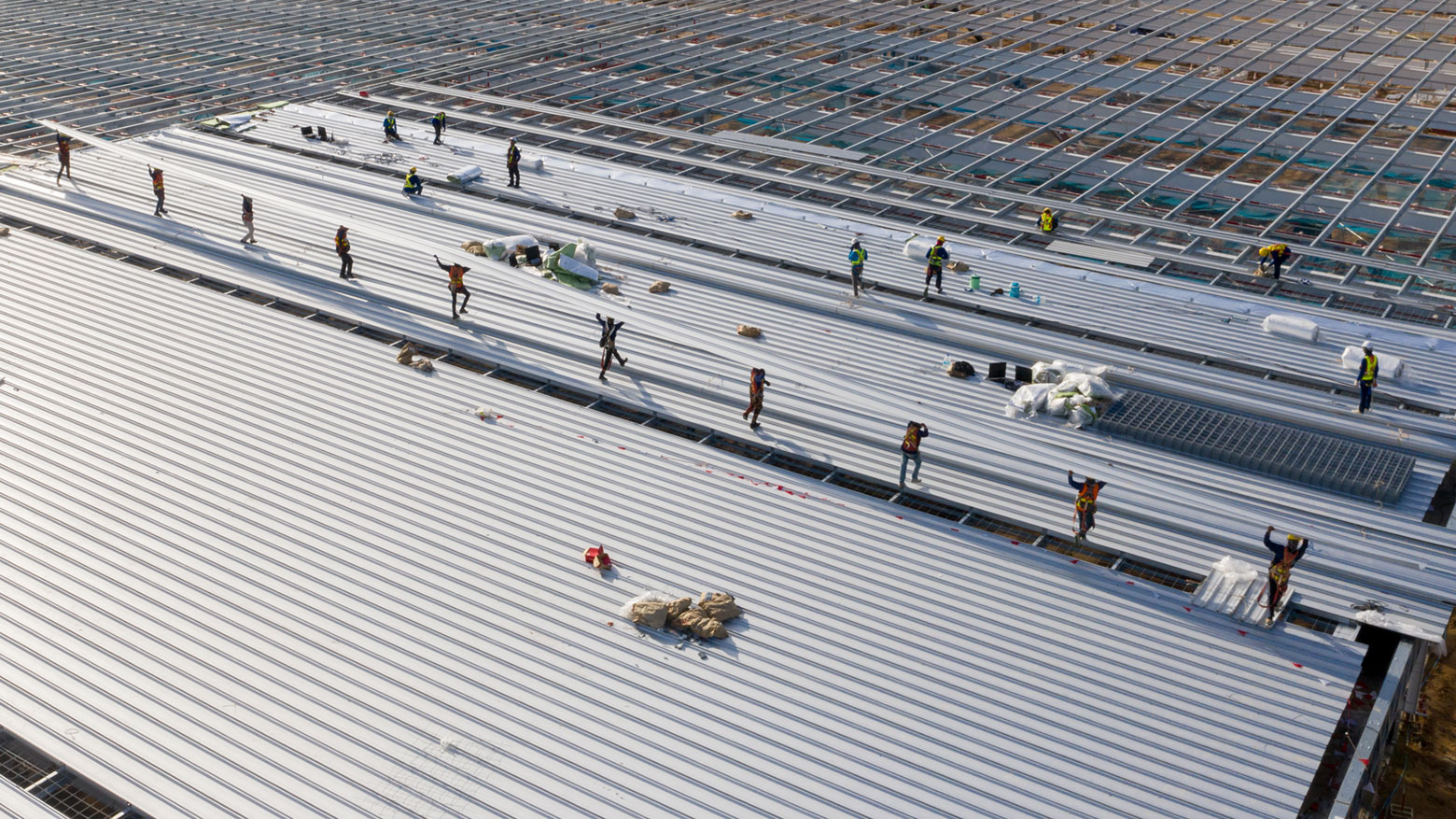
Terminal, hangar, and cargo-facility roofing at Des Moines International Airport and the region's general aviation fields.
An airport never stops, so the roof plan starts with operations
You cannot roof an airport the way you roof a strip mall. The building runs around the clock, every access point and lift location is governed by airfield operations, and large stretches of roof sit over spaces full of travelers where a leak or a falling tool is not an inconvenience but an incident. So the first deliverable on an aviation project is not a membrane spec. It is an operations plan that the airport's facilities department and safety program will actually sign off on, worked out before mobilization rather than improvised on the apron.
Des Moines International Airport, DSM, is the state's primary commercial airport, serving the capital region and feeding a steady cargo and logistics presence on the airport's south side. A multi-year terminal modernization and the freight operations around the field keep commercial roofing demand alive, all of it in a climate that hands roofs hard freeze-thaw cycling and real ice-dam and snow-drift exposure on long, flat terminal expanses. The aviation footprint does not stop at the terminal: reliever and general-aviation fields ring the metro and carry their own hangar and support-building roof work.
General aviation and reliever fields serving the metro:
Terminal roofs carry loads a commercial box never sees
The roof on a terminal or an airside structure faces conditions a comparable warehouse never does. Airside roofs near taxiways and gates take jet blast, which means the membrane adhesion and any ballast have to be specified well beyond standard wind-uplift assumptions. Terminal HVAC is denser and heavier than typical commercial, so the curbed-penetration count climbs and each oversized curb becomes its own engineered flashing detail rather than a stock part. And terminal roofs tend to be long, low-slope expanses where the slightest drainage error turns into standing water, so the tapered insulation and drainage design carry near-zero tolerance for ponding before Iowa's freeze-thaw turns that water into a problem at every seam.
Iowa winters punish a flat terminal roof
A wide, nearly flat terminal roof is a snow shelf for four or five months a year. Snow drifts deep against parapets, mechanical screens, and the raised clerestories common on terminal designs, and those drifts concentrate load far past an even snowfall. When the building heat works up through the deck and melts the underside of that snow, the meltwater runs to the cold eaves and refreezes into ice dams that back water up under the membrane and into the seams. We design for that reality, sizing primary and overflow drainage for snowmelt rather than summer rain, detailing the edge metal and scuppers to handle ice rather than just shed water, and confirming the insulation thickness and continuity keep the deck cold enough to limit the melt-refreeze cycle in the first place. On an occupied terminal, a winter leak over a ticketing hall or a security checkpoint is the kind of event that drives the whole reroof decision, so the winter performance of the assembly is not a detail we leave to chance.
Everything airside runs on badging and credentialing
Access is the throughline on every aviation project, and it is not negotiable. Work near airside areas runs through the airport's safety program, with material deliveries, crane lifts, and apron work confined to approved windows and coordinated with the operations team and, where required, the notice process for airspace and equipment. Crew members do not set foot on airside without confirmed authorization, and we build the badging and credentialing timeline into the bid schedule so it is a planned step, not a discovery at mobilization. The same access discipline applies across the whole campus, not just the terminal.
Aviation-adjacent buildings are their own scope
The terminal is only part of the picture. Cargo and freight buildings, rental-car centers, FBO and corporate hangars, aircraft-maintenance facilities, and on-campus hotels each present a different roofing problem, but the airport-coordination requirement follows every one of them. Cargo facilities behave like high-throughput logistics buildings with airside access rules layered on top. Maintenance hangars combine large clear-span roofs with the fume and ventilation considerations of an active shop. We scope each building for what it actually is while holding the same access and safety standard across the campus.
Hangars are big, open, and uplift-driven
High-bay hangars, whether a single private bay or a multi-unit FBO complex, are dominated by large clear-span roofs over wide-flange steel or pre-engineered building systems. Those spans generate serious wind-uplift loads, and the fastening pattern and seam geometry have to be engineered to the structure and the local wind data, not carried over from a smaller building. The big door openings change the pressure behavior inside the building during high wind, which we account for in the attachment design. We specify and install both single-ply and standing-seam metal systems on these structures across the metro and the surrounding reliever fields.
Airport Terminal & Aviation Facility Roofing Questions
How do you schedule work at an operating airport like DSM?
We develop a phased plan approved by the airport facilities department and its safety program. Material deliveries, crane lifts, and any airside work are confined to approved windows and coordinated with operations and the required airspace notice process. It is a standard part of our project setup, not an exception.
What roof systems suit large-span terminal roofs?
Most terminal reroofing uses a TPO or PVC single-ply membrane over tapered insulation engineered to improve drainage and eliminate ponding. New high-bay aviation structures and hangars often call for standing-seam metal. The choice depends on the existing deck, load capacity, and operational constraints, and we develop the spec after walking the roof with your facilities engineer.
How do you handle the density of HVAC and mechanical penetrations on a terminal?
Terminal HVAC density runs well above standard commercial. Our pre-project survey documents every penetration, curb height, and clearance before we build the work plan, and oversized curbs and complex through-penetrations are flashed as individual engineered details rather than stock patterns.
Can you work on airside structures near active aprons and gates?
Yes, with appropriate badging and in full coordination with airfield operations. Airside work requires additional pre-planning and crew credentialing, which we build into the bid timeline. We do not mobilize crew without confirmed airside authorization.
Do you handle hangar roofing for FBOs and general-aviation facilities?
Yes. Hangar roofing, from a single private bay to a multi-unit FBO complex, is a regular part of our work in the metro. High-bay hangars over wide-flange steel or pre-engineered systems need fastening and seam designs engineered for their uplift and thermal-movement behavior, which we provide.
What to send before the roof walk
Send the roof address, leak photos, roof age if known, access instructions, tenant limits, prior reports, and the deadline driving the decision. That lets the first visit focus on the roof condition instead of chasing basic context.
Questions Owners Ask
Can this work happen while the building is occupied?
Often yes. The scope should cover access, safety, dry-in, staging, noise, interior protection, and the times when tenants or operations cannot be interrupted.
What changes the cost most?
Wet insulation, deck condition, edge metal, layer count, access, roof size, code triggers, weather timing, and the amount of repeated damage usually move the cost.
How is the condition documented?
The roof file should include photos, locations, material notes, observed defects, temporary repairs, remaining deficiencies, and recommended next steps.