
Commercial roofing for office buildings, professional parks, and corporate campuses.
The Principal Financial Group headquarters campus in downtown Des Moines, spanning multiple city blocks in the heart of Iowa's capital, is one of the most significant office roofing assets in the state. Principal's buildings range from modern glass towers to connected mid-rise structures, all requiring active roof management that keeps a Fortune 500 company's physical home in the condition that reflects its brand. Des Moines has developed a sophisticated Class A office market driven by its insurance, financial services, and agricultural finance industries, and the roofing standards expected by the tenants and owners in this market are commensurate with the sector's professional standards.
Occupied-building protocols on the Principal campus and comparable Des Moines corporate headquarters buildings must navigate the specific challenge of working over financial services operations that cannot tolerate system interruptions or security breaches. Des Moines-area corporate tenants in financial services have IT infrastructure, compliance recording systems, and customer data operations that create elevated sensitivity to any construction activity that could disrupt operations or create unauthorized access routes to secure spaces. Roofing contractors working on Des Moines financial services office buildings should have established security clearance protocols, experience with camera monitoring on active projects, and references from comparable financially sensitive corporate environments.
Aesthetic and green roof considerations for Des Moines office buildings are shaped by the city's growing sustainability profile and the competition for corporate tenants who use sustainability credentials as employer branding tools. Principal Financial Group and other major Des Moines employers have made public sustainability commitments that require supporting building systems, and building owners competing for their tenancy must offer facilities that contribute to rather than hinder those sustainability programs. Cool roof membranes with ENERGY STAR certification are essentially a baseline specification expectation for Des Moines Class A office buildings, and several buildings in the downtown and Jordan Creek areas have explored green roof sections on visible terrace levels.
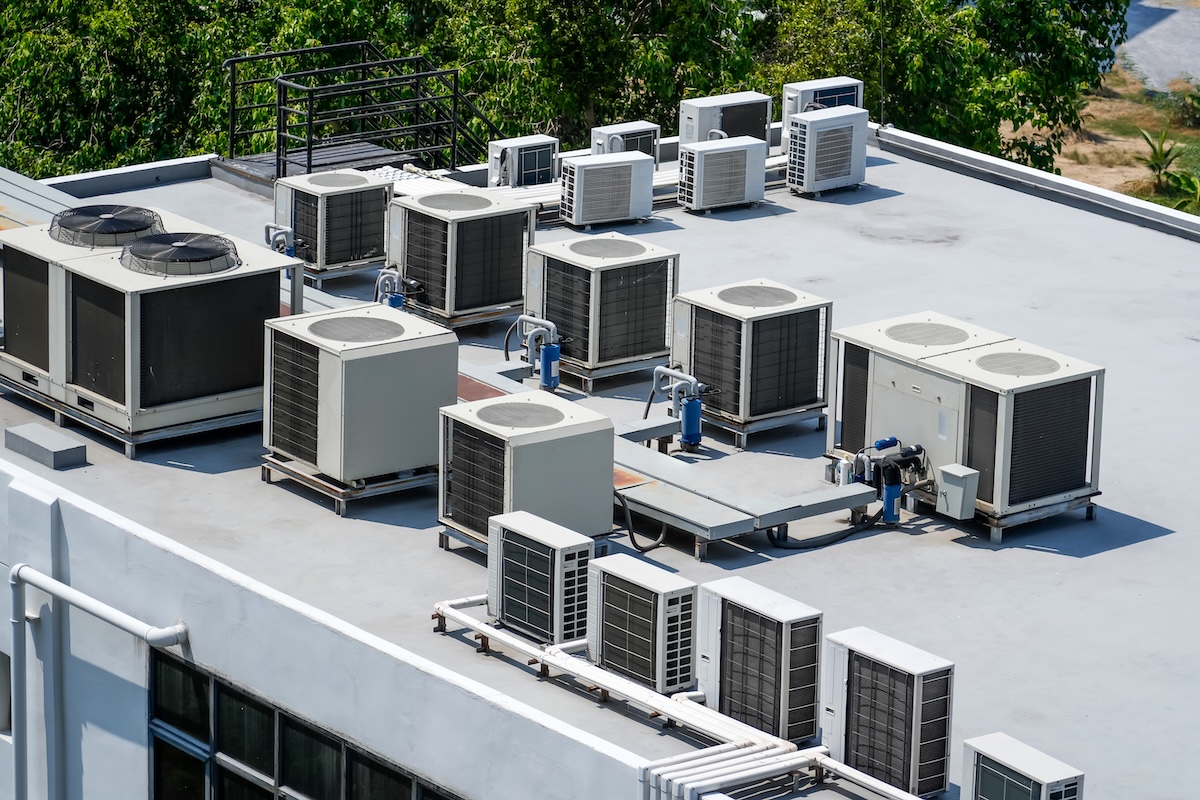
Multi-RTU coordination on Des Moines corporate campus buildings involves the full complexity of a Midwest climate — equipment sized for both heating and cooling operation, with the heating season representing the dominant energy cost and the cooling season creating the peak demand periods that most affect tenant experience. A Des Moines office building with 25 to 40 rooftop units serviced by multiple mechanical contractors requires a formal coordination protocol that the roofing contractor manages during the project to ensure no unit is left inoperable overnight during a period when temperatures drop to a level requiring tenant heating. The coordination plan should be documented in writing before the project begins and reviewed with building management and the mechanical contractor.
Iowa energy code compliance for Des Moines office buildings follows the Iowa Energy Code, which incorporates ASHRAE 90.1 commercial provisions. Iowa's Climate Zone 5A places relatively demanding minimum continuous insulation requirements on commercial roof assemblies, and many older downtown Des Moines office buildings built before current code adoption do not meet current minimums. A replacement project bringing insulation to current code levels is justified on financial grounds for most Des Moines office buildings, and MidAmerican Energy has offered commercial energy efficiency programs that sometimes provide incentives for qualifying roof insulation upgrades — owners should confirm current program terms before finalizing specifications.
Reflective and cool membrane specifications for Des Moines office buildings require the same heating-season consideration that applies across Iowa's climate zone. For all-electric or natural-gas-heated office buildings, the net annual energy impact of a white reflective membrane versus a standard membrane depends on the building's thermal envelope characteristics, mechanical system type, and the relative costs of heating and cooling energy. As Des Moines summer temperatures and cooling season duration have increased in recent years, the energy balance has shifted toward clearer advantage for cool roof membranes in most office building types. An energy model remains the most defensible basis for the specification decision on large Des Moines office buildings.
Lease renewal protection in Des Moines's office market, where the downtown core has seen the challenges of suburban competition and remote work adoption that affect most mid-tier Midwest markets, is an important strategic consideration for building owners investing in roof replacement. The Des Moines office market has shown resilience from its financial services anchor tenants, but Class B building owners in older stock must demonstrate active capital investment to retain tenants who have newer suburban options. A roof replacement in the context of a broader building reinvestment program signals building ownership intent to maintain the asset competitively, which supports lease rate stability and tenant retention in a market where tenants have negotiating leverage.
Spring severe weather is a meaningful secondary roofing risk for Des Moines office buildings. Iowa sits within the central US tornado and severe thunderstorm corridor, and the spring storm season from March through June produces hail events, high winds, and occasionally significant structural wind loads on office buildings throughout Polk County. A post-severe-weather inspection protocol that sends a qualified roofing contractor to document conditions after any event with confirmed large hail or high wind maintains the documentation trail needed for insurance claims and catches damage before it becomes a water intrusion event during the next significant rain.
Cost per square foot for Des Moines office building roof replacement typically ranges from $10 to $15 for low-rise and mid-rise buildings in the downtown and suburban corridors, reasonable for a Midwest market with a competitive commercial roofing contractor community. The Des Moines market's qualified commercial contractors include several firms with strong corporate office references and manufacturer certifications. Fall project starts are generally well-suited to Des Moines, with mild temperatures and low contractor competition compared to the peak summer months, allowing building owners who plan ahead to capture better scheduling and pricing than reactive projects that compete for summer availability.
What to send before the roof walk
Send the roof address, leak photos, roof age if known, access instructions, tenant limits, prior reports, and the deadline driving the decision. That lets the first visit focus on the roof condition instead of chasing basic context.
Questions Owners Ask
Can this work happen while the building is occupied?
Often yes. The scope should cover access, safety, dry-in, staging, noise, interior protection, and the times when tenants or operations cannot be interrupted.
What changes the cost most?
Wet insulation, deck condition, edge metal, layer count, access, roof size, code triggers, weather timing, and the amount of repeated damage usually move the cost.
How is the condition documented?
The roof file should include photos, locations, material notes, observed defects, temporary repairs, remaining deficiencies, and recommended next steps.