
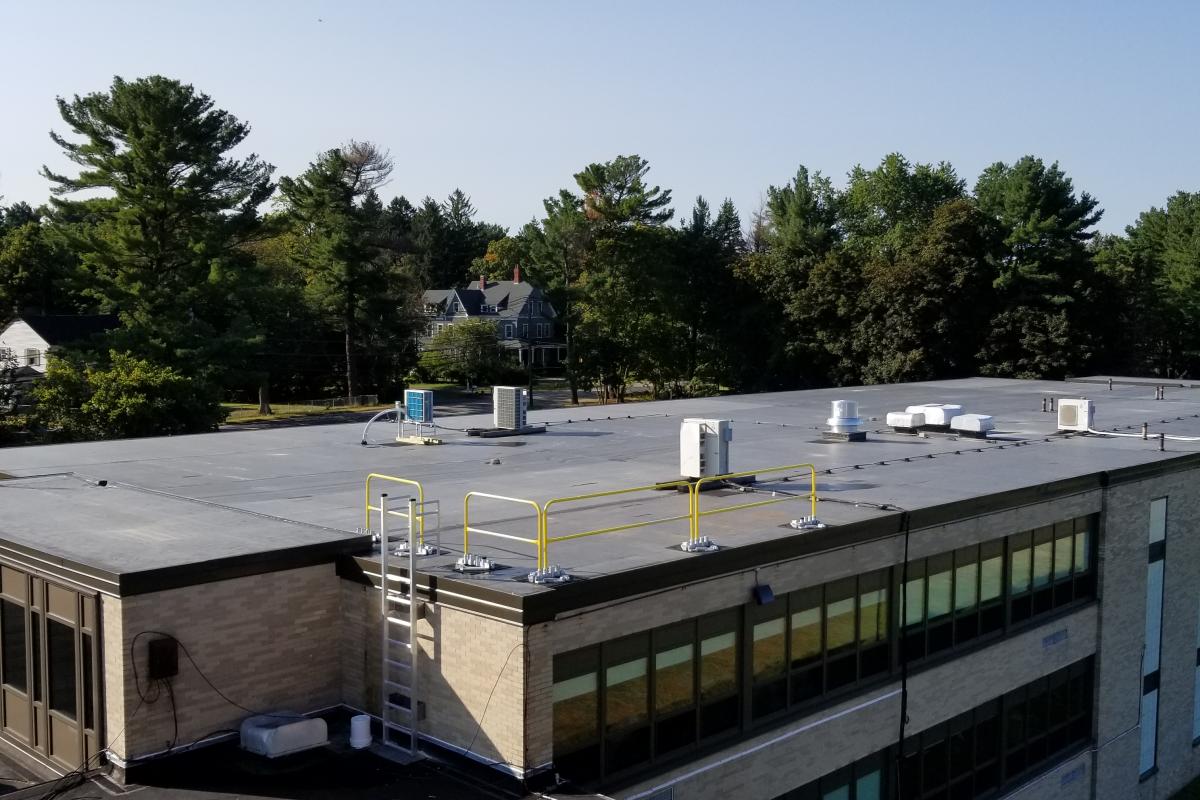
Commercial roofing for government buildings, municipal facilities, and public infrastructure.
Des Moines functions as the capital of Iowa and the seat of Polk County, which means the city hosts an unusually rich concentration of publicly owned buildings relative to its population. The Des Moines City Hall on East First Street, the Polk County Courthouse—a Beaux-Arts landmark completed in 1906—the Downtown Des Moines Public Library with its distinctive glass pavilion, Polk County's administrative complex, multiple Des Moines Police and Fire Department facilities, and the cluster of state government buildings along Grand Avenue all compete for the attention of qualified roofing contractors in the central Iowa market. The density of government building assets in a mid-sized Midwest city creates a stable, predictable demand stream for contractors who understand how to navigate Iowa's public procurement system.
Iowa procurement for public improvements is governed by Iowa Code Chapter 26, which establishes competitive bidding requirements, bid security obligations, and performance and payment bond mandates for public works contracts above defined dollar thresholds. The City of Des Moines publishes roofing solicitations through the Iowa League of Cities procurement network, the city's own vendor management portal, and the Des Moines Register as required by public notice statutes. Polk County follows similar Chapter 26 procedures for county-owned buildings. Iowa law requires that all bids be accompanied by bid security in the form of a bid bond or certified check, and that awarded contractors furnish performance and payment bonds equal to 100 percent of the contract amount. These requirements are applied consistently, and contractors who have not previously worked under Iowa public procurement should familiarize themselves with the Chapter 26 framework before submitting a first response.
Central Iowa's climate subjects Des Moines municipal roofs to a punishing seasonal cycle that includes heavy spring rainfall, severe convective storms that deliver both hail and straight-line winds, brutally hot and humid summers, and winters with significant snowfall and ice formation. The March 2019 derecho that caused widespread wind damage across the Iowa River Valley exposed vulnerabilities in several Des Moines public buildings, and subsequent inspections revealed that some fire station and library roofs had sustained uplift damage that required emergency temporary repairs before permanent re-roofing could be scheduled. This event accelerated the city's adoption of enhanced wind uplift testing requirements in its roofing specifications, with FM 1-90 and FM 1-105 uplift classifications now appearing routinely in Des Moines public bid documents.
The Polk County Courthouse presents one of the most demanding historic roofing challenges in the Des Moines market. Built with a classical copper dome, ornate copper gutters, and a steep-slope slate roof, the 1906 courthouse requires specialty preservation contractors who understand both the original construction methods and the conservation treatments that extend the life of historic copper and slate without replacing them unnecessarily. The Iowa State Historic Preservation Office reviews work on National Register-listed properties when public funds are involved, and Polk County's Facilities Director must obtain SHPO concurrence before proceeding with re-roofing work on the dome or principal roof slopes. Local preservation advocacy groups in Des Moines have historically monitored restoration projects on the courthouse and other civic landmarks, adding an informal accountability layer beyond the formal regulatory review.
Iowa's energy code and Des Moines's own sustainability commitments drive energy-related specifications into municipal roofing contracts. The city adopted the 2021 International Energy Conservation Code as its local standard, and the Des Moines Climate Action and Adaptation Plan, adopted in 2021, includes specific targets for reducing municipal building energy consumption. Re-roofing projects on city-owned facilities are treated as opportunities to upgrade insulation to current code minimums, and the Des Moines Metropolitan Planning Organization has supported energy efficiency improvements in public buildings through technical assistance grants that help city staff develop better scopes for capital roofing projects. The flat-roof municipal buildings that dominate Des Moines's civic core are prime candidates for reflective membrane systems that reduce summer cooling loads in a climate with significant cooling degree days.
Des Moines Fire Department station roofing projects carry specific operational constraints that inform how contractors approach both their technical proposals and their project schedules. The city operates multiple fire stations in the downtown core, including Station , and any roofing work at these stations must accommodate the constant movement of apparatus responding to calls from the city's busiest response districts. Bid specifications for fire station work in Des Moines include explicit requirements for contractor coordination with the on-duty crew, minimum unobstructed clearance for apparatus egress at all times, and notification protocols for the city's Emergency Communications Center before any work begins that might affect the station's operational status. Liquidated damages provisions tied to operational disruptions are standard in these contracts.
Federal prevailing wage requirements affect Des Moines municipal roofing when HUD Community Development Block Grant funds, CDBG-DR disaster recovery dollars, or EPA environmental justice funding flows into the project budget. Des Moines is an entitlement city under the HUD CDBG program, and the city's Neighborhood Services department administers these federal dollars subject to the Davis-Bacon Act and Related Acts compliance framework. Roofing contractors must pay workers the federal prevailing wage for the Polk County roofing classification, submit weekly certified payroll, and post applicable wage determinations at the job site. Iowa does not maintain a separate state prevailing wage law, so Davis-Bacon is the primary labor standard contractors encounter on federally funded Des Moines public roofing work.
Warranty structures on Des Moines municipal roofing contracts have evolved as the city's Facilities Services Division has gained experience with warranty claims on older installed systems. The current standard calls for manufacturer-backed NDL warranties of at least 20 years on fully adhered or mechanically attached membrane systems, and the city has begun requiring that warranty documents be submitted for legal review before contract execution rather than as a post-installation closeout deliverable. This change emerged from a dispute on a prior library project where warranty language submitted at closeout contained exclusions that the city had not intended to accept. Des Moines now specifies approved manufacturer lists and requires sample warranty documents as part of the bid package to prevent similar situations.
The State of Iowa General Services Enterprise maintains a parallel portfolio of state-owned buildings in Des Moines that includes the Iowa State Capitol, the Hoover Building, the Lucas State Office Building, and numerous other structures requiring periodic re-roofing attention. Contractors who establish credibility with City of Des Moines Facilities Services often find that the state's procurement staff views that track record favorably when evaluating qualifications for state projects. Des Moines is one of the few markets in the United States where a roofing contractor can win work on a city, county, and state project in the same calendar year with minimal additional administrative overhead, provided they have invested in understanding the distinct procurement frameworks that each level of government requires.
What to send before the roof walk
Send the roof address, leak photos, roof age if known, access instructions, tenant limits, prior reports, and the deadline driving the decision. That lets the first visit focus on the roof condition instead of chasing basic context.
Questions Owners Ask
Can this work happen while the building is occupied?
Often yes. The scope should cover access, safety, dry-in, staging, noise, interior protection, and the times when tenants or operations cannot be interrupted.
What changes the cost most?
Wet insulation, deck condition, edge metal, layer count, access, roof size, code triggers, weather timing, and the amount of repeated damage usually move the cost.
How is the condition documented?
The roof file should include photos, locations, material notes, observed defects, temporary repairs, remaining deficiencies, and recommended next steps.