
Architectural Sheet Metal is scoped around commercial metal details, wall panels, copings, and transitions.
Industrial roofing in Des Moines sits at the intersection of two major forces that shape everything we do in this market: the Midwest's four-season weather severity, and Iowa's identity as the agricultural and logistics crossroads of the continent. The I-80/I-35 interchange in Des Moines is one of the most significant logistics chokepoints in the country — the point where the east-west and north-south interstate systems cross in the center of the United States — and the industrial facilities that have grown up around that interchange to serve the national distribution network define the largest and most operationally demanding category of roofing work we do here. Add in the ag-processing facilities, the food and grain storage infrastructure, and the growing data center and financial services corporate campuses, and you have an industrial roofing market that is more diverse and more demanding than most people outside the region expect.
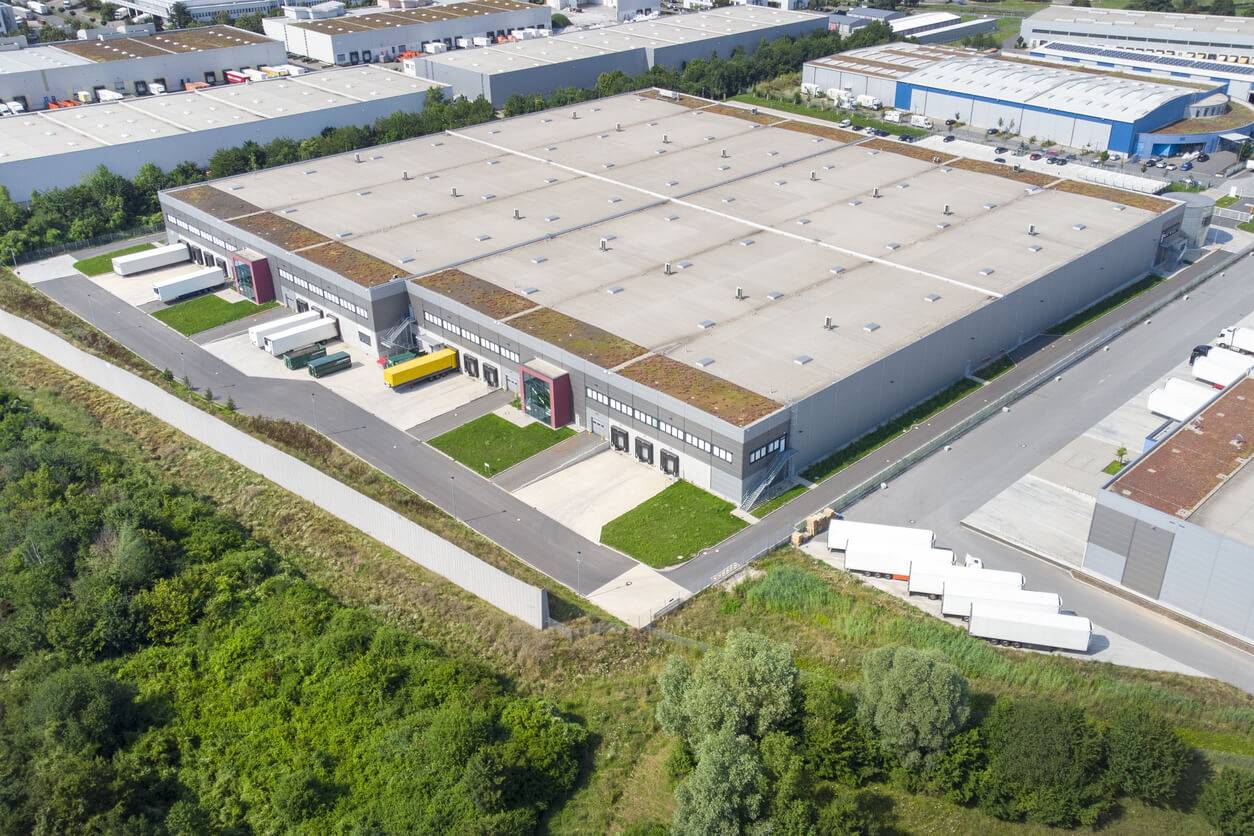
The I-80/I-35 interchange area on Des Moines's south side has become one of the most active industrial development zones in the Midwest. Distribution centers, fulfillment operations, trucking terminals, and logistics support facilities cluster around the interchange in a pattern that mirrors other major interstate crossings — but the Des Moines interchange carries a specific strategic importance because it sits at the center of the Midwest distribution geography. A facility here can reach , and the building owners and logistics operators who understand that have invested accordingly. We work on multiple buildings in that corridor and maintain ongoing maintenance relationships with several of the largest facilities there.
Altoona, east of Des Moines along I-80, has emerged as a significant logistics and distribution hub in its own right, with major e-commerce and retail distribution operations establishing footprints there over the past decade. The buildings in Altoona are generally modern construction — tilt-wall and steel frame buildings with TPO roofing systems — and they're the kind of well-managed assets where institutional building owners expect comprehensive maintenance documentation, formal condition reports, and capital planning projections on a schedule that aligns with their asset management cycles. We provide that level of service as a standard component of our maintenance agreements, not as an add-on.
Ankeny, north of Des Moines along I-35, is one of Iowa's fastest-growing suburbs and the home of a significant concentration of industrial and light manufacturing activity. John Deere's operations in the area — including the Des Moines Works plant in Ankeny — are among the largest single manufacturing facilities in the region. Agricultural equipment manufacturing has specific roofing demands: large-bay buildings with overhead crane systems, significant interior heat from welding and metalworking operations, and the scale of building that makes roofing logistics as complex as the roofing itself. We've worked on manufacturing facilities of comparable scale and understand the project management requirements that large manufacturing plant roofing demands.
Principal Financial Group's corporate campus in downtown Des Moines and the broader financial services and data center development in the metro represent a category of commercial roofing work that requires a different set of sensitivities than standard industrial. Data centers — and Des Moines has attracted significant hyperscale data center investment because of its central location, power grid reliability, and land availability — are mission-critical facilities where a roof failure is a business emergency, not a maintenance item. We approach data center roofing with the same rigorous pre-job planning, installation documentation, and quality verification that we bring to semiconductor fab facilities elsewhere in our market territory.
Iowa's climate is the full Midwest package delivered with full intensity. Thirty-four inches of annual rainfall spread across spring and summer thunderstorm events. Thirty-three inches of snow. Freeze-thaw cycling that runs from October through March, with some of the most aggressive cycling in the central United States during the November and March transition periods. And a hail season that sits in the corridor between Tornado Alley to the southwest and the Great Lakes storm track to the northeast, producing significant hail events multiple times per year. Every roof system we install in Des Moines is specified to perform across that full weather range, not optimized for average conditions.
Hail damage is a consistent driver of both emergency repair and insurance claim work in the Des Moines market. Iowa's location produces hail events of significant scale — storms with 1-inch-plus hail occur multiple times per season in most years, and occasional severe events with 2-inch or larger hail can require full roof replacement on buildings where the membrane is damaged beyond viable repair. We respond to post-storm inspection requests rapidly, document damage thoroughly with photographs and measurements for insurance submission, and work with property managers and building owners to distinguish cosmetic impact damage from functional damage that compromises waterproofing performance. That distinction matters enormously for insurance claims and for the building owner's actual risk exposure.
Des Moines International Airport industrial area — the logistics and cargo facilities on the airport's south and east sides — is a steady source of roofing work for our commercial division. The airport's role as a regional cargo hub has grown alongside Des Moines's emergence as a logistics anchor, and the industrial buildings that support that cargo activity require the same operational coordination and scheduling discipline that any airport-adjacent industrial project demands. We handle the coordination with the airport authority and schedule our most operationally disruptive work during the lowest-traffic periods, maintaining continuous communication with the building's facilities management team throughout any project.
For new industrial construction and major re-roofing in Des Moines, our standard specification for large-bay industrial buildings is 60-mil TPO fully adhered over polyiso insulation with tapered insulation to internal drains. In this climate, the fully adhered specification is the right choice — mechanically attached systems can allow wind-driven precipitation to penetrate at fastener rows during the extended periods of winter wind and precipitation that Des Moines experiences, and the resulting wet insulation is a costly problem that proper adhesion prevents. We specify drain sumps at every primary drain location, secondary overflow scuppers at every low point, and pre-manufactured flashing corners and termination details throughout.
Iowa's agricultural processing sector — the grain elevators, meatpacking facilities, food processing plants, and ethanol production operations that form the industrial backbone of the Iowa economy — creates a specialized category of roofing demand that generic commercial contractors aren't prepared for. Food processing and agricultural operations generate interior humidity, exhaust conditions, and chemical exposures that drive specific requirements for vapor management, membrane compatibility, and penetration detailing. We've worked on enough Iowa food processing and ag-processing buildings to understand those requirements as standard practice, not as exceptional conditions requiring special accommodation. The agricultural and food sector is part of what makes Des Moines's industrial roofing market distinctive, and it's a sector we serve with the same capability we bring to logistics and manufacturing facilities.
The interchange location concentrates a specific type of industrial building in the area — large-format, high-throughput distribution facilities that are managed to institutional standards by national REITs and logistics operators. Those buildings have high roofing quality expectations, require formal documentation and warranty coverage, and represent the kind of asset where deferred maintenance is not an acceptable operating strategy. The interchange also creates a customer base that includes local building owners who have invested in industrial property to serve the logistics market, and those owners need the same quality of work at a scale and budget that fits their individual building. We work for both categories of building owners in the interchange area — the institutional portfolio managers and the individual building owners — with consistent quality standards adapted to each client's specific needs.
Practically, it means you should have a documented post-storm inspection protocol that gets activated within 48–72 hours of any hail event that reports significant stone size in your area. The distinction between a minor hail event that requires monitoring and a major event that requires immediate inspection is roughly 1.5 inches — stones that size and larger can cause functional damage to TPO, EPDM, and modified bitumen membranes that compromises waterproofing. Insurance policies often have time-sensitive reporting requirements for storm damage, so delayed inspections can create claim complications. We provide post-storm emergency inspection services for our maintenance clients within defined response time windows, and we document findings in a format that supports the insurance claim process.
The primary differences are interior humidity management, exhaust penetration complexity, and membrane material compatibility. Food processing and ag-processing facilities generate significant interior moisture — steam, evaporative cooling exhaust, and condensation from temperature-controlled production areas all contribute to a moisture load that, without proper vapor management in the roof assembly, migrates into the insulation and compromises it over time. We specify vapor retarders at the appropriate location in the assembly for each specific facility type, and we coordinate with the facility engineer on interior temperature and humidity profiles so the assembly is designed for actual operating conditions. Exhaust penetrations on food processing facilities can carry grease-laden air that attacks certain membrane materials — we specify membrane types and penetration flashing materials that are compatible with the exhaust chemistry.
Large manufacturing plant roofing projects are as much project management challenges as they are technical roofing challenges. Buildings of 500,000 to 1 million square feet require dedicated on-site project management, material logistics plans that coordinate deliveries with the plant's inbound and outbound shipping schedule, and daily production reports that keep the plant's facilities team informed. We section large manufacturing roofs into work zones that allow us to progress systematically while maintaining a dry, watertight condition in all non-active sections at the end of each work day. Overhead crane facilities require specific attention to fall protection planning — rooftop work above active crane bays needs to be coordinated with the crane operations supervisor. We've developed phased work protocols for manufacturing facilities specifically, and those protocols make large manufacturing plant projects manageable and predictable for both our team and the building owner's operations team.
The optimal window for major industrial re-roofing work in Des Moines is May through September. That window provides the most consistent warm temperatures for membrane installation and adhesive application, the longest daily work hours for production efficiency, and the lowest risk of significant weather disruption mid-project. April can work for projects that need to be underway before summer, but freeze risk is present through mid-April and installation temperature requirements for adhesives need to be respected. October becomes risky by mid-month as temperatures approach the minimums for installation products. For large projects that will run multiple months, starting in May gives the best combination of installation conditions throughout the project duration. We plan major Des Moines re-roofing projects to be substantially complete by mid-October.
What to send before the roof walk
Send the roof address, leak photos, roof age if known, access instructions, tenant limits, prior reports, and the deadline driving the decision. That lets the first visit focus on the roof condition instead of chasing basic context.
Questions Owners Ask
Can this work happen while the building is occupied?
Often yes. The scope should cover access, safety, dry-in, staging, noise, interior protection, and the times when tenants or operations cannot be interrupted.
What changes the cost most?
Wet insulation, deck condition, edge metal, layer count, access, roof size, code triggers, weather timing, and the amount of repeated damage usually move the cost.
How is the condition documented?
The roof file should include photos, locations, material notes, observed defects, temporary repairs, remaining deficiencies, and recommended next steps.