
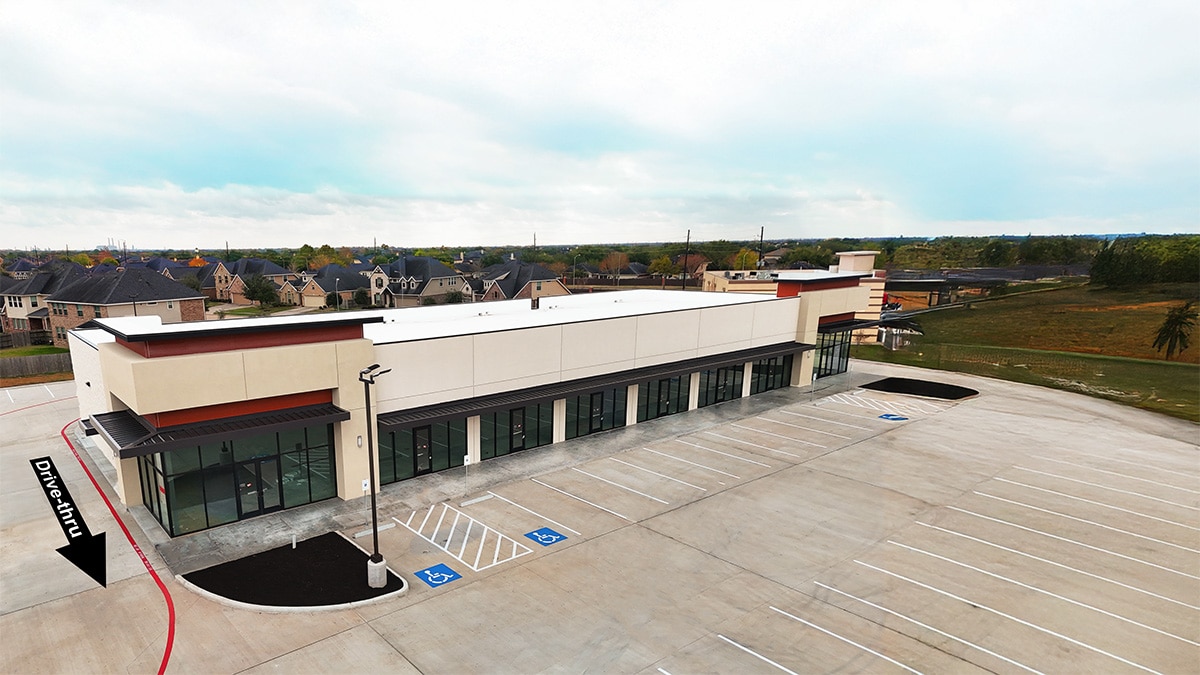
Long clear-span auditorium decks, a rooftop crowded with HVAC, and a sound-and-insulation problem most flat roofs never face — cinema roofing centered on all of it.
The Span Over the Seats Is the Whole Challenge
What makes a cinema roof different from any other flat commercial roof is what is under it: large auditoriums with no interior columns. A multiplex with eight to twelve screens carries clear-span decks of 80 to 150 feet over each house, and those spans deflect under wind, snow, and equipment loads in ways a retail-box fastening pattern was never meant to handle. We size cinema fastener density and insulation attachment to the actual deck type and span, not to a template borrowed from a strip center, because that is where templated theater roofs come apart.
Des Moines has the screen count to keep this work steady. Multiplexes anchor the major retail nodes — the Jordan Creek area in West Des Moines, the Merle Hay corridor, and the regional centers off the I-35 and I-80 interchanges — alongside the independent and historic houses downtown and in the East Village. Add Iowa's snow loads to those long spans and the structural demands on a cinema roof are real, which is why we treat the deck as the starting point rather than an afterthought.
Sound and Insulation, Not Just Weather
A cinema roof has an acoustic job most flat roofs do not. Rain drumming on a thin assembly over a quiet dramatic scene is a real complaint, and a high-occupancy auditorium needs the thermal and sound separation that comes from the right insulation depth and density. We treat the insulation layer as part of the building's acoustic and energy performance, not just an R-value to hit, and we make sure the assembly we install supports the experience the operator is selling, not just the code minimum.
A Rooftop as Dense as a Hospital
The mechanical load on a multiplex is concentrated and heavy. Each auditorium usually gets its own dedicated rooftop HVAC unit, on top of concession exhaust, lobby heating vents, and condensers for the walk-in coolers serving food service. The penetration cluster over a typical Des Moines multiplex rivals what we see on a hospital. Every curb, duct, and conduit run is flashed and documented individually before new membrane goes over it — there is no single detail that covers that crowd.
Reading the Deck Before We Spec
Cinemas are typically built on steel deck or concrete over structural steel, and the two call for different attachment approaches. Steel deck takes mechanical attachment directly; concrete usually wants an adhered or, where loads allow, ballasted system. On any theater reroof we pull a core sample first to confirm the existing insulation layers, moisture content, and total weight-in-place before deciding between a recover and a full tear-off. Guessing at what is up there is how a recover ends up trapping wet insulation.
Cinemas run from early afternoon through late night, seven days a week, which puts them closer to a 24-hour operation than a 9-to-5 building. We sequence tear-off and dry-in so every section is watertight before evening screenings begin, and we coordinate with facilities management on HVAC shutdown windows needed for curb or penetration work. Loading-dock access for HVAC service crews, marquee electrical runs, and evening foot traffic near the entries all factor into how we stage the work so the roof job never collides with a sold-out Friday night.
Marquees, Canopies, and the Chronic Leaks
Marquee signs and entry canopies are where older theaters leak. The attachment points where supports penetrate the membrane, and the canopy-to-building transitions at the entrances, are classic chronic-leak sources. We treat each of those as an individual flashing item and re-flash the entry transitions as part of the project rather than leaving the most visible part of the building as the weak point.
What We Handle on Cinema Roofs
Movie Theater Roofing Questions
Most often 60-mil or 80-mil TPO mechanically attached over tapered polyiso. The tapered iso corrects the drainage problems that build up on flat theater roofs over decades, and white TPO meets the cool-roof energy code that most jurisdictions now apply to commercial reroofs. Around the rooftop HVAC units we add reinforced walkway pads to protect the membrane from service traffic.
Long-span steel deck needs fastener patterns and pull-out testing matched to the deck rib depth and gauge — older short-rib deck holds fasteners less well than modern 3-inch rib. We verify the deck before specifying attachment, and where deflection is a concern we may go to an adhered or hybrid system to avoid concentrating point loads at the seams.
Yes. We plan the work around the screening schedule, sequencing tear-off and dry-in so each section is watertight before evening shows, and coordinating with facilities on any HVAC shutdown windows needed for curb or penetration work.
By the roof square (100 square feet), based on the membrane spec, the condition of the existing assembly, penetration density, and access. Most multiplex reroofs include tapered insulation, which adds cost up front but extends membrane life by getting rid of ponding water. We give a fixed price after a roof walk and a core sample review.
Yes. Marquee and canopy attachment points that penetrate the membrane are treated as individual flashing items, and the entry canopy-to-building transitions — a common chronic leak on older theaters — are re-flashed as part of the project.
What to send before the roof walk
Send the roof address, leak photos, roof age if known, access instructions, tenant limits, prior reports, and the deadline driving the decision. That lets the first visit focus on the roof condition instead of chasing basic context.
Questions Owners Ask
Can this work happen while the building is occupied?
Often yes. The scope should cover access, safety, dry-in, staging, noise, interior protection, and the times when tenants or operations cannot be interrupted.
What changes the cost most?
Wet insulation, deck condition, edge metal, layer count, access, roof size, code triggers, weather timing, and the amount of repeated damage usually move the cost.
How is the condition documented?
The roof file should include photos, locations, material notes, observed defects, temporary repairs, remaining deficiencies, and recommended next steps.