
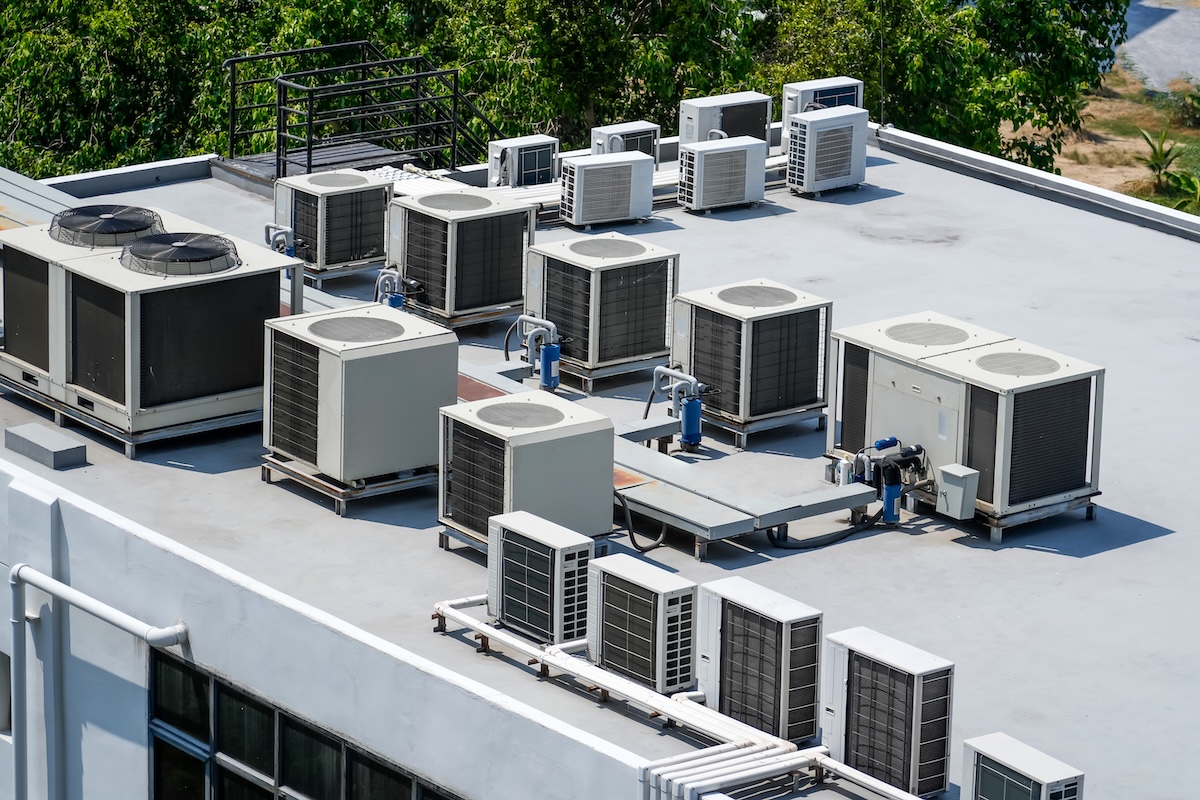
Multi-tenant low-slope roofs with a forest of penetrations, undocumented tenant changes, and risk that spikes at every lease turnover — flex roofing scoped for that reality.
The Building Type That Refuses to Stay One Thing
Flex space is the chameleon of the commercial inventory. One building might hold a light-manufacturing shop, a distribution operation, a contractor's service yard, and a small office tenant all at once, and the mix changes with the lease cycle. The roof has to ride out occupancy changes, tenant-improvement work, and the full range of rooftop loads that come with industrial flex use. That variability, not the membrane itself, is the real challenge, and it is what we plan around first.
Des Moines has a deep flex inventory because of how the metro is laid out. Multi-tenant flex and light-industrial parks fill the Urbandale and Grimes employment areas off Hickman and Meredith, the corridors feeding the I-35 and I-80 interchanges, the Ankeny and Bondurant industrial zones to the north and east, and the older southeast-side industrial pockets near the airport. Across that stock you find everything from 1970s tilt-wall with aging built-up roofs to recent pre-engineered metal buildings, and the right scope depends on which one is in front of us.
Penetrations Nobody Wrote Down
A single-user industrial building has a roof someone can account for. A multi-tenant flex roof accumulates years of tenant-improvement work — added HVAC units, new electrical and gas runs, equipment dropped in outside the original loading plan — and most of it never makes it into the property records. That is why every flex scope we run starts with a penetration inventory: we photograph and map every penetration on the roof, compare it against the original drawings where they exist, and flag the non-standard or poorly sealed ones for remediation before new membrane goes down. Skip that step and you inherit somebody else's leaks under your warranty.
Matching the System to the Building You Actually Have
Flex roofs in Des Moines split roughly into two worlds. For tilt-wall and concrete buildings, 60-mil TPO mechanically attached over new polyiso is the workhorse spec, with tapered insulation added where drainage has gone flat. On buildings with heavy rooftop-equipment density or constant foot traffic from multiple tenants' HVAC contractors, stepping up to 80-mil TPO or 60-mil PVC fully adhered buys real puncture and traffic resistance that pays off over the roof's life. Pre-engineered metal buildings are a different decision: depending on panel condition, purlin spacing, and load capacity, a standing-seam recover or a silicone-coated metal restoration often beats a full tear-off. We spec and install both approaches here.
Lease Transitions Are When Flex Roofs Leak
The riskiest moment in a flex building's life is a tenant turnover. When a tenant leaves and their rooftop HVAC comes off, the curb openings are usually capped with temporary protection that fails within a rain event or two. Vacant bays also collect debris faster than occupied ones, and clogged drains over an empty bay can go unnoticed for months. Any flex roof inspection during a lease transition should confirm curb-cap status, verify that former-tenant penetrations are properly sealed, and check that the drains are clear. We build those checks into our lease-transition surveys because that is exactly where deferred problems turn into interior damage.
Coordinating Across Tenants Without Chaos
Multi-tenant work lives or dies on coordination. We start from a bay-by-bay occupancy map and lease-contact list from property management, identify which tenants have active rooftop equipment and which bays are vacant, and flag tenants sensitive to noise or HVAC downtime. Sequencing and daily dry-in plans go through property management; tenants get advance notice but communicate through the property manager rather than directly with the crew, which keeps the project from fracturing into a dozen separate conversations.
Built for Owners and Portfolio Managers
For investors and property managers, the value is in predictability. We price flex roofing by the roof square (100 square feet) based on the membrane spec, existing assembly condition, penetration density, and bay configuration, with fixed-price proposals after a roof walk and a core sample where one is warranted. Owners running multiple flex properties get standardized condition reports they can drop straight into capital planning across the portfolio.
Industrial Flex Space Roofing Questions
We assume they exist. Our pre-project survey photographs and maps every roof penetration, compares it to the original drawings where we have them, and flags any non-standard or poorly sealed penetrations for remediation before new membrane goes down. That is what keeps inherited leaks from becoming warranty disputes after the job.
For tilt-wall and concrete flex buildings, 60-mil TPO mechanically attached over tapered polyiso is the most common and cost-effective choice. Where there is heavy rooftop equipment or constant HVAC-contractor foot traffic across tenants, 80-mil TPO or 60-mil PVC fully adhered is worth the added cost for the puncture and traffic resistance.
We start with a bay-by-bay occupancy map and lease-contact list from property management, identify active rooftop equipment, vacant bays, and noise- or downtime-sensitive tenants, then route all sequencing and daily dry-in plans through the property manager. Tenants get advance notice but communicate through management, not directly with the crew.
By the roof square (100 square feet), based on membrane spec, existing assembly condition, penetration density, and bay configuration, with a fixed-price proposal after a roof walk and a core sample where needed. Portfolio owners get standardized condition reports that feed straight into capital planning across multiple properties.
Yes. Pre-engineered metal buildings call for a different approach than flat membrane roofs. We weigh metal recover options — silicone-coated metal or retrofit standing seam — against a full tear-off based on current panel condition, purlin spacing, and load capacity, and we install both here in Des Moines.
What to send before the roof walk
Send the roof address, leak photos, roof age if known, access instructions, tenant limits, prior reports, and the deadline driving the decision. That lets the first visit focus on the roof condition instead of chasing basic context.
Questions Owners Ask
Can this work happen while the building is occupied?
Often yes. The scope should cover access, safety, dry-in, staging, noise, interior protection, and the times when tenants or operations cannot be interrupted.
What changes the cost most?
Wet insulation, deck condition, edge metal, layer count, access, roof size, code triggers, weather timing, and the amount of repeated damage usually move the cost.
How is the condition documented?
The roof file should include photos, locations, material notes, observed defects, temporary repairs, remaining deficiencies, and recommended next steps.